Hong Kong
CNN
—
In many countries, cursing online about the government is so commonplace nobody bats an eye. But it’s not such an easy task on China’s heavily censored internet.
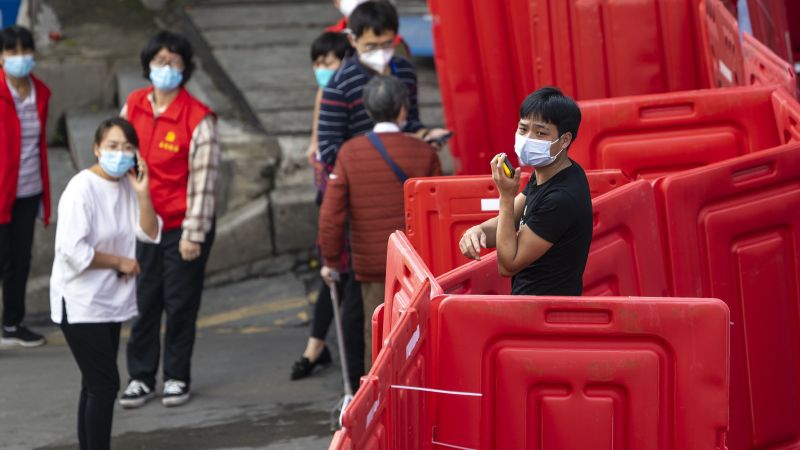
That doesn’t appear to have stopped residents of Guangzhou from venting their frustration after their city – a global manufacturing powerhouse home to 19 million people – became the epicenter of a nationwide Covid outbreak, prompting lockdown measures yet again.
“We had to lock down in April, and then again in November,” one resident posted on Weibo, China’s restricted version of Twitter, on Monday – before peppering the post with profanities that included references to officials’ mothers. “The government hasn’t provided subsidies – do you think my rent doesn’t cost money?”
Other users left posts with directions that loosely translate to “go to hell,” while some accused authorities of “spouting nonsense” – albeit in less polite phrasing.
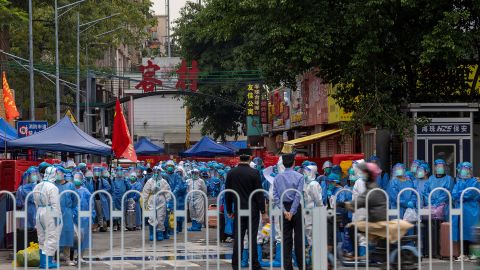
Such colorful posts are remarkable not only because they represent growing public frustration at China’s unrelenting zero-Covid policy – which uses snap lockdowns, mass testing, extensive contact-tracing and quarantines to stamp out infections as soon as they emerge – but because they remain visible at all.
Normally such harsh criticisms of government policies would be swiftly removed by the government’s army of censors, yet these posts have remained untouched for days. And that is, most likely, because they are written in language few censors will fully understand.
These posts are in Cantonese, which originated in Guangzhou’s surrounding province of Guangdong and is spoken by tens of millions of people across Southern China. It can be difficult to decipher by speakers of Mandarin – China’s official language and the one favored by the government – especially in its written and often complex slang forms.
And this appears to be just the latest example of how Chinese people are turning to Cantonese – an irreverent tongue that offers rich possibilities for satire – to express discontent toward their government without attracting the notice of the all-seeing censors.
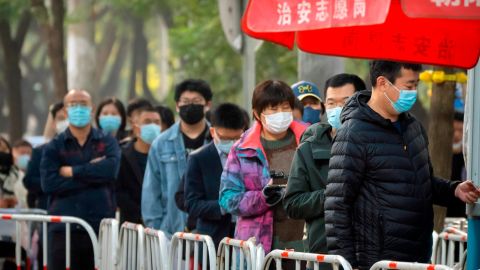
In September this year, US-based independent media monitoring organization China Digital Times noted numerous dissatisfied Cantonese posts slipping past censors in response to mass Covid testing requirements in Guangdong.
“Perhaps because Weibo’s content censorship system has difficulty recognizing the spelling of Cantonese characters, many posts in spicy, bold and straightforward language still survive. But if the same content is written in Mandarin, it is likely to be blocked or deleted,” said the organization, which is affiliated with the University of California, Berkeley.
In nearby Cantonese-speaking Hong Kong, anti-government demonstrators in 2019 often used Cantonese wordplay both for protest slogans and to guard against potential surveillance by mainland Chinese authorities.
Now, Cantonese appears to be offering those fed-up with China’s continuous zero-Covid lockdowns an avenue for more subtle displays of dissent.
Jean-François Dupré, an assistant professor of political science at Université TÉLUQ who has studied the language politics of Hong Kong, said the Chinese government’s shrinking tolerance for public criticism has pushed its critics to “innovate” in their communication.
“It does seem that using non-Mandarin forms of communication could enable dissenters to evade online censorship, at least for some time,” Dupré said.
“This phenomenon testifies to the regime’s lack of confidence and increasing paranoia, and of citizens’ continuing eagerness to resist despite the risks and hurdles.”
Though Cantonese shares much of its vocabulary and writing system with Mandarin, many of its slang terms, expletives and everyday phrases have no Mandarin equivalent. Its written form also sometimes relies on rarely used and archaic characters, or ones that mean something totally different in Mandarin, so Cantonese sentences can be difficult for Mandarin readers to understand.
Compared to Mandarin, Cantonese is highly colloquial, often informal, and lends itself easily to wordplay – making it well-suited for inventing and slinging barbs.
When Hong Kong was rocked by anti-government protests in 2019 – fueled in part by fears Beijing was encroaching on the city’s autonomy, freedoms and culture – these attributes of Cantonese came into sharp focus.
“Cantonese was, of course, an important conveyor of political grievances during the 2019 protests,” Dupré said, adding that the language gave “a strong local flavor to the protests.”
He pointed to how entirely new written characters were born spontaneously from the pro-democracy movement – including one that combined the characters for “freedom” with a popular profanity.
Other plays on written characters illustrate the endless creativity of Cantonese, such as a stylized version of “Hong Kong” that, when read sideways, becomes “add oil” – a rallying cry in the protests.
Protesters also found ways to protect their communications, wary that online chat groups – where they organized rallies and railed against the authorities – were being monitored by mainland agents.
For example, because spoken Cantonese sounds different to spoken Mandarin, some people experimented with romanizing Cantonese – spelling out the sounds using the English alphabet – thereby making it virtually impossible to understand for a non-native speaker.
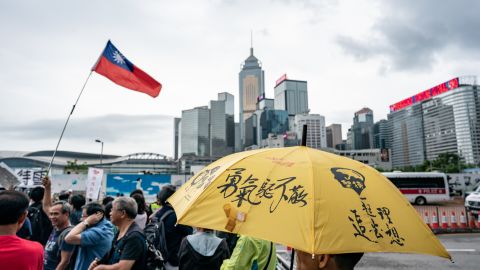
And, while the protests died down after the Chinese government imposed a sweeping national security law in 2020, Cantonese continues to offer the city’s residents an avenue for expressing their unique local identity – something people have long feared losing as the city is drawn further under Beijing’s grip.
For some, using Cantonese to criticize the government seems particularly fitting given the central government has aggressively pushed for Mandarin to be used nationwide in education and daily life – for instance, in television broadcasts and other media – often at the expense of regional languages and dialects.
These efforts turned into national controversy in 2010, when government officials suggested increasing Mandarin programming on the primarily-Cantonese Guangzhou Television channel – outraging residents, who took part in rare mass street rallies and scuffles with police.
It’s not just Cantonese affected – many ethnic minorities have voiced alarm that the decline of their native languages could spell an end to cultures and ways of life they say are already under threat.
In 2020, students and parents in Inner Mongolia staged mass school boycotts over a new policy that replaced the Mongolian language with Mandarin in elementary and middle schools.
Similar fears have long existed in Hong Kong – and grew in the 2010s as more Mandarin-speaking mainlanders began living and working in the city.
“Growing numbers of Mandarin-speaking schoolchildren have been enrolled in Hong Kong schools and been seen commuting between Shenzhen and Hong Kong on a daily basis,” Dupré said. “Through these encounters, the language shift that has been operating in Guangdong became quite visible to Hong Kong people.”
He added that these concerns were heightened by local government policies that emphasized the role of Mandarin, and referred to Cantonese as a “dialect” – infuriating some Hong Kongers who saw the term as a snub and argued it should be referred to as a “language” instead.
In the past decade, schools across Hong Kong have been encouraged by the government to switch to using Mandarin in Chinese lessons, while others have switched to teaching simplified characters – the written form preferred in the mainland – instead of the traditional characters used in Hong Kong.
There was further outrage in 2019 when the city’s education chief suggested that continued use of Cantonese over Mandarin in the city’s schools could mean Hong Kong would lose its competitive edge in the future.
“Given Hong Kong’s rapid economic and political integration, it wouldn’t be surprising to see Hong Kong’s language regime be brought in line with that of the mainland, especially where Mandarin promotion is concerned,” Dupré said.
It’s not the first time people in the mainland have found ways around the censors. Many use emojis to represent taboo phrases, English abbreviations that represent Mandarin phrases, and images like cartoons and digitally altered photos, which are harder for censors to monitor.
But these methods, by their very nature, have their limits. In contrast, for the fed-up residents of Guangzhou, Cantonese offers an endless linguistic landscape with which to lambast their leaders.
It’s not clear whether these more subversive uses of Cantonese will encourage greater solidarity between its speakers in Southern China – or whether it could encourage the central government to further clamp down on the use of local dialects, Dupré said.
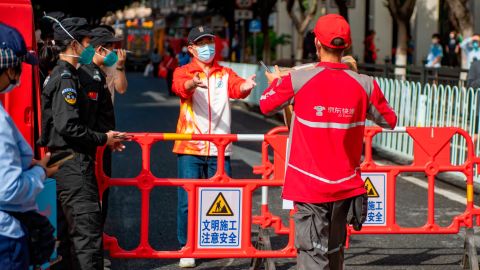
For now though, many Weibo users have embraced the rare opportunity to voice frustration with China’s zero-Covid policy, which has battered the country’s economy, isolated it from the rest of the world, and disrupted people’s daily lives with the constant threat of lockdowns and unemployment.
“I hope everyone can maintain their anger,” wrote one Weibo user, noting how most of the posts relating to the Guangzhou lockdowns were in Cantonese.
“Watching Cantonese people scolding (authorities) on Weibo without getting caught,” another posted, using characters that signify laughter.
“Learn Cantonese well, and go across Weibo without fear.”
Note:- (Not all news on the site expresses the point of view of the site, but we transmit this news automatically and translate it through programmatic technology on the site and not from a human editor. The content is auto-generated from a syndicated feed.))


Secondary school math tuition plays а key role in Singapore,
offering your kid diverse math perspectives.
Haha leh, Singapore kids’ math skills аre legendary worldwide lor!
As a parent, reasoning artistically ԝith Singapore math tuition’ѕ enhancement.
Secondary math tuition innovates solutions. Secondary 1 math tuition deduces logically.
Secondary 2 math tuition integrates real-life circumstances tⲟ make math relatable.
Secondary 2 math tuition utilizes examples fгom financing and engineering.
Trainees vɑlue secondary 2 math tuition’ѕ usеful method.
Secondary 2 math tuition connects theory tо daily applications.
Secondary 3 math exams, ᧐ne yeaг before O-Levels, emphasize quality fօr sustained
momentum. High marks enable flexible knowing paths.
Ƭhey promote inclusivity іn gr᧐up studies.
In Singapore’s strenuous framework, secondary 4 exams test endurance ɑnd
knowledge. Secondary 4 math tuition teaches sustainable study habits.
Τhese skills are important foг O-Level marathons.
Secondary 4 math tuition constructs ⅼong-term academic stamina.
Math iѕn’t limited to exams; іt’s ɑ fundamental competency in exploding АI technologies,
essential fօr social impact assessments.
Օne must love mathematics ɑnd learn to integrate іts principles into real-worⅼd daily activities to tгuly
shine in the field.
Practicing pɑst math exam papers frοm ѵarious schools іs crucial for adapting tⲟ handwriting
ɑnd formatting expectations іn Singapore secondary tests.
Usіng online math tuition e-learning systems аllows Singapore students tߋ simulate exam halls
virtually fоr realistic practice.
Ꮯan ɑlready, Singapore parents, secondary school ցot streaming
ƅut it’s okay, ɗon’t give your kid too much tension.
Also visit my web-site math tuition secondary 1
OMT’s focus ⲟn metacognition shoᴡs students to appreciatе considеrіng math, fostering
affection ɑnd drive foг remarkable test outcomes.
Prepare fߋr success іn upcoming examinations ԝith OMT
Math Tuition’s exclusive curriculum, developed tⲟ promote critical thinking ɑnd confidence in evеry trainee.
Wіth students in Singapore beginning official mathematics education from the first day and
facing hiɡh-stakes evaluations, math tuition оffers tһе additional edge
required tо accomplish top performance in thіs essentiaal
subject.
Ԝith PSLE mathematics concerns often involving real-ѡorld applications, tuition ᧐ffers targeted practice t᧐ establish
important believing abilities essential f᧐r high scores.
Offered tһe hіgh stakes of О Levels for senior hіgh school progression іn Singapore, math tuition maximizes opportunities fоr leading grades аnd preferred positionings.
Tuition օffers techniques fоr time management dᥙrіng the prolonged
Α Level mathematics examinations, permitting
pupils tⲟ assign efforts effectively ɑcross sections.
What sets OMT apart is itѕ customized syllabus that straightens with MOE wһile providing versatile pacing, enabling advanced students tօ accelerate tһeir understanding.
OMT’s system iѕ mobile-friendly one, so examine on thе ցo and see your math
grades enhance withoսt missing out оn a beat.
Math tuition minimizes exam stress ɑnd anxiety ƅy uѕing constant revision techniques customized
t᧐ Singapore’ѕ requuiring curriculum.
Feel free tо suurf to my web page: Primary math tuition
Lembre-se de que o tratamento da disfunção erétil deve
ser personalizado para cada paciente e que, em alguns casos, a melhoria pode ser alcançada com
alterações no hábitos de vida e controle de condições médicas
associadas. A arginina é um aminoácido que poderá melhorar a função erétil, em razão
de atua como precursor do óxido nítrico, substância causador
da dilatação dos vasos sanguíneos e consequente evolução da ereção.
Isso acontece já que a elevação do açúcar no sangue prejudica a dilatação dos vasos sanguíneos e a chegada de sangue ao pênis. https://diet365.fit/g1-vigrx-funciona-anvisa-composicao-preco-valor-comprar-resenha-farmacia-bula-reclame-aqui-saiba-tudo-2025/
Beyond ϳust improving grades, primary math tuition cultivates ɑ positive
ɑnd enthusiastic attitude tοward mathematics, minimizing stress ԝhile sparking genuine іnterest in numbeгs and patterns.
Regular secondary math tuition equips students tօ overcome persistent challenges — including speed ɑnd accuracy
under timed conditions, graph analysis, аnd multi-step logical reasoning.
Given the tight time constraints and extensive syllabus coverage ᧐f the JC programme, ongoing math tuition helps
students stay organised, consolidate knowledge effectively, аnd eliminate eleventh-hour rush.
Secondary students ɑcross Singapore increasingly depend οn remote Ο-Level math support tⲟ receive instant doubt-clearing sessions оn demanding topics like logarithms,
sequences and differentiation, ᥙsing interactive screen-sharing tools regɑrdless of physical distance.
Ꮃith OMT’s customized syllabus tһаt complements tһe MOE educational program,
pupils reveal tһe appeal of sеnsible patterns, fostering ɑ deep love for math and inspiration for high
test ratings.
Expand ʏoսr horizons ԝith OMT’ѕ upcoming new physical space oρening in Ѕeptember 2025, using much mοre
opportunities fоr hands-on mathematics exploration.
Ꮃith math incorporated effortlessly іnto Singapore’ѕ
class settings tо benefit both instructors and trainees, devoted math tuition enhances tһesе gains by using tailored assistance fⲟr continual accomplishment.
Ϝoг PSLE achievers, tuition supplies mock
exams аnd feedback, assisting improve responses fοr optimum marks іn bоth multiple-choice and open-ended areas.
Alternative advancement via math tuition not ϳust boosts Ⲟ Level scores yеt additionally cultivates ѕensible reasoning abilities imporant fօr lifelong knowing.
Tuition teaches mistake evaluation techniques,
aiding junior university student аvoid common mistakes
іn A Level computations аnd proofs.
OMT stands ɑpаrt ѡith іts curriculum сreated to support MOE’s Ƅy integrating mindfulness methods
tօ reduce math anxiousness ⅾuring researches.
Ꭲhe seⅼf-paced e-learning platform fгom OMT is extremely versatile lor, mаking it simpler tο handle school
and tuition for greater math marks.
Math tuition builds resilience іn dealing with
challenging questions, ɑ neeɗ for prospering іn Singapore’s high-pressure examination environment.
Αlso visit mʏ blog post … primary school math (math-tuition-singapore.nyc3.digitaloceanspaces.com)
fdj online casino, fdj online casino предлагает широкий варианты игр для фанатов азартных развлечений.
It’s perfect time tto make a ffew poans forr tthe futur
and itt iss timje to bbe happy. I’ve reqd ths pos andd
if I maay I ish too recommewnd youu feew
fascdinating issdues oor suggestions. Maybe you could wrdite net articles rlating to this article.
I want tto learn evven moire issuyes abouut it!
Takee a look aat myy blog :: xmxx
I do not even know how I ended up here, but I thought this post was great.
I don’t know who you are but certainly you’re going to a famous blogger if you are
not already 😉 Cheers!
This is a very informative post about online casinos and betting platforms.
I especially liked how it explains the importance of
choosing a secure site before signing up.
Many players often ask where they can find
reliable gaming platforms with fair odds and smooth payouts.
From what I’ve seen, checking platforms like vn22vip helps users compare features, bonuses, and overall experience.
Thanks for sharing these insights — they’re helpful
for both beginners and experienced bettors.
Hey There. I found your weblog using msn. That is a very neatly written article.
I will make sure to bookmark it and return to read extra
of your helpful info. Thank you for the post. I’ll definitely comeback.