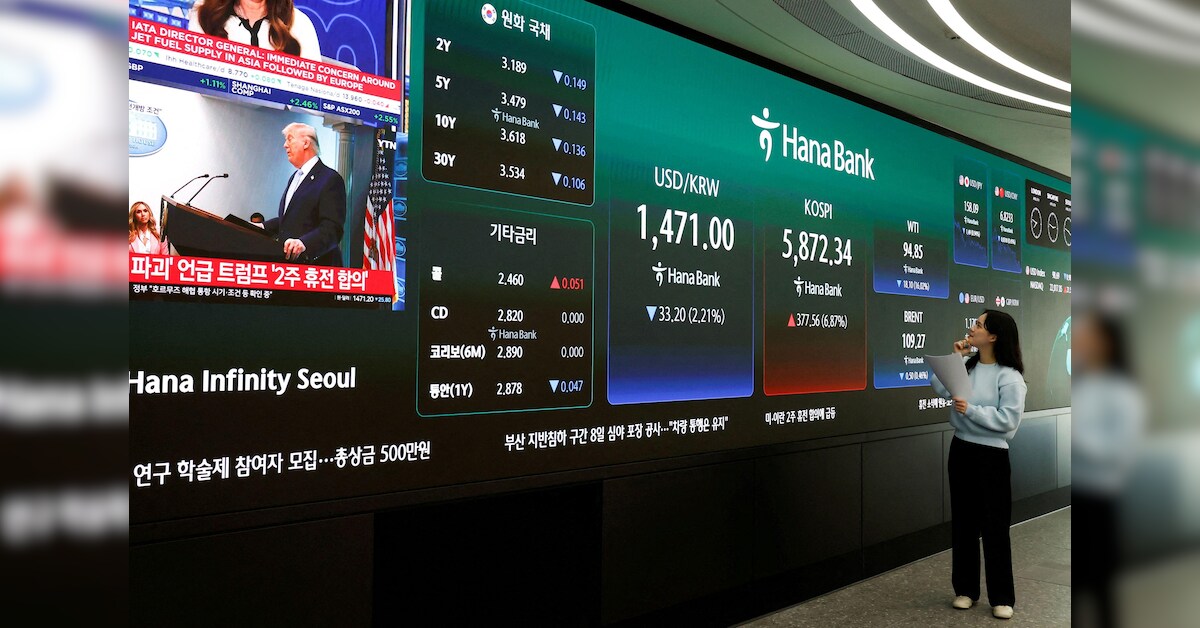
South Korea’s benchmark Kospi rose nearly 4 per cent on Thursday, entering technical bull-market territory as chip stocks led a sharp recovery from last month’s sell-off.
The index gained as much as 4.8 per cent during the session, extending its rebound from the July 30 low to around 22 per cent, according to Bloomberg. It closed at 6,840.67, up 3.98 per cent.
The Kospi fell 22 per cent in July, its worst monthly decline since the 2008 global financial crisis. It has gained more than 60 per cent so far this year, although it remains about 24 per cent below its late-June peak, Bloomberg reported.
Who led the rally?
The gains came as investor interest returned to technology hardware stocks on expectations of continued spending on artificial intelligence infrastructure by large technology companies.
AI demand supports chip outlook
Recent results from global technology companies have pointed to continued spending on artificial intelligence, supporting demand for memory chips used in AI infrastructure, CNBC reported.
David Morrison, senior market analyst at Trade Nation, told CNBC, “The AI spending boom is far from over,” citing strong results from US AI-related companies.
Experts, cited by CNBC, said memory stocks have started to outperform the broader technology sector for the first time since June. The trend could support further gains in South Korean equities, given the influence of Samsung Electronics and SK Hynix on the Kospi, they added.
The near-term demand outlook for memory chips also remains supported by the expansion of AI into new applications and greater use of AI systems, according to Bloomberg.
“Because of AI agents and physical AI, memory demand has exploded, but we entered into this with a quite limited supply capacity – that’s where the bottleneck is,” Qian Zhang, emerging markets equities investment specialist at Baillie Gifford, was quoted as saying by Bloomberg.
“We’re not saying the world will be building data centers forever at this speed, but that is a real physical bottleneck that only a few companies in this world can resolve,” Zhang added.
Market volatility eases
The sharp fall in July led to a record number of trading halts as intraday swings of more than 5 per cent in the Kospi became common.
Market volatility has since eased. Bloomberg reported that a gauge of volatility had fallen to its lowest level since April.
South Korean regulators have also introduced measures to curb demand for single-stock leveraged exchange-traded funds linked to chipmakers. Daily trading in these products has fallen after new minimum cash deposit requirements.
Foreign investors bought Korean stocks on Thursday, although they remain net sellers for the year. Bloomberg reported that overseas investors had withdrawn more than $100 billion from the market this year.
US inflation supports sentiment
US inflation data also supported market sentiment. Consumer prices rose 0.2 per cent in July from the previous month, in line with economists’ expectations. A key measure of underlying inflation recorded its slowest pace since March 2021.
The data reduced expectations of an immediate interest-rate increase by the US Federal Reserve and supported US-listed chip stocks.
Note:- (Not all news on the site expresses the point of view of the site, but we transmit this news automatically and translate it through programmatic technology on the site and not from a human editor. The content is auto-generated from a syndicated feed.))