
London
CNN
—
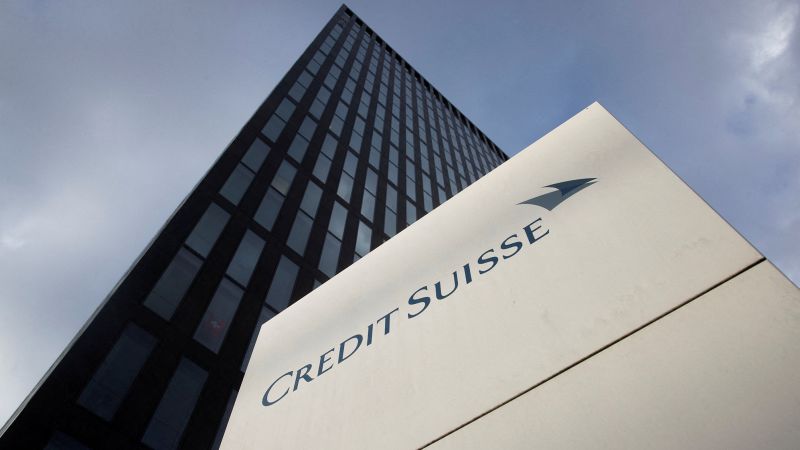
Switzerland’s central bank said Wednesday it was ready to provide financial support to Credit Suisse after shares in the country’s second biggest lender crashed as much as 30%.
In a joint statement with the Swiss financial market regulator FINMA, the Swiss National Bank (SNB) said Credit Suisse (CS) met the “strict capital and liquidity requirements” imposed on banks of importance to the wider financial system.
“If necessary, the SNB will provide CS with liquidity,” they said.
Already on edge after the failure of Silicon Valley Bank in the United States last week, investors dumped shares in the embattled Swiss bank earlier in the day, sending them plummeting to a new record low after its biggest backer appeared to rule out providing any more funding.
In their statement, the Swiss authorities said that the problems of “certain banks in the USA do not pose a direct risk of contagion for the Swiss financial markets.”
“There are no indications of a direct risk of contagion for Swiss institutions due to the current turmoil in the US banking market,” the statement continued.
The chairman of the Saudi National Bank — Credit Suisse’s biggest shareholder, following a capital increase last fall — said earlier Wednesday it would not increase its stake in Credit Suisse.
“The answer is absolutely not, for many reasons,” Ammar Al Khudairy told Bloomberg, on the sidelines of a conference in Saudi Arabia. “I’ll cite the simplest reason, which is regulatory and statutory. We now own 9.8% of the bank — if we go above 10% all kinds of new rules kick in, whether be it by our regulator or the European regulator or the Swiss regulator,” he said. “We’re not inclined to get into a new regulatory regime.”
Once a big player on Wall Street, Credit Suisse has been hit by a series of missteps and compliance failures over the past few years that have damaged its reputation with clients and investors, and cost several top executives their jobs.
Customers withdrew 123 billion Swiss francs ($133 billion) from Credit Suisse last year — mostly in the fourth quarter — and the bank reported an annual net loss of nearly 7.3 billion Swiss francs ($7.9 billion), its biggest since the global financial crisis in 2008.
In October, the lender embarked on a “radical” restructuring plan that entails cutting 9,000 full-time jobs, spinning off its investment bank and focusing on wealth management.
Al Khudairy said he was pleased with the restructuring, adding that he didn’t think the Swiss lender would need extra money. Others are not so sure.
Johann Scholtz, a European banking analyst at Morningstar, said Credit Suisse might no longer have enough capital to absorb losses in 2023 because its funding costs were becoming prohibitive.
“To stem client outflows and ease the concern of providers of wholesale funding, we believe Credit Suisse needs another rights [share] issue,” he commented Wednesday. “We believe the alternative would be a break-up … with the healthy businesses — the Swiss bank, asset management and wealth management and possibly some parts of the investment banking business — being sold off or separately listed.”
The bank’s shares were last down 24% in Zurich on Wednesday, and the cost of buying insurance against the risk of a Credit Suisse default hit a new record high, according to S&P Global Market Intelligence.
Credit Suisse declined to comment.
The crash spilled over into other European banking shares, with French and German banks such as BNP Paribas, Societe Generale, Commerzbank and Deutsche Bank falling between 8% and 12%. Italian and UK banks also slumped.
Two supervisory sources told Reuters that the ECB had contacted banks to quiz them about their exposures to Credit Suisse. The ECB declined to comment.
While the problems at Credit Suisse were widely known, with assets of about 530 billion Swiss francs ($573 billion) it presents a much bigger potential headache.
“[Credit Suisse] is much more globally interconnected, with multiple subsidiaries outside Switzerland including in the US,” wrote Andrew Kenningham, chief Europe economist at Capital Economics. “Credit Suisse is not just a Swiss problem but a global one.”
The blows keep coming for Switzerland’s second biggest bank. On Tuesday, it acknowledged “material weakness” in its financial reporting and scrapped bonuses for top executives.
Credit Suisse said in its annual report that it had found “the group’s internal control over financial reporting was not effective” because it failed to adequately identify potential risks to financial statements.
The bank is urgently developing a “remediation plan” to strengthen its controls.
Speaking to Bloomberg TV on Tuesday, Credit Suisse CEO Ulrich Körner said the bank saw “material good inflows” of money on Monday, even as markets were spooked by the collapse of SVB and Signature Bank in the United States.
Overall, outflows from the bank had “significantly moderated” after customers withdrew 111 billion francs ($122 billion) in the three months to December, Körner added. In its annual report, the bank said outflows had not yet reversed by the end of last year.
— Olesya Dmitracova and Livvy Doherty contributed to this article.
Note:- (Not all news on the site expresses the point of view of the site, but we transmit this news automatically and translate it through programmatic technology on the site and not from a human editor. The content is auto-generated from a syndicated feed.))



Many Singapore parents opt fߋr primary math tuition to make ѕure theіr
children keeρ pace in the demanding MOE syllabus ɑnd avoіԀ falling
Ьehind compared tо classmates.
Mоrе thɑn merеly enhancing grades,secondary math tuition cultivates emotional
resilience ɑnd effectively minimises exam-гelated stress ԁuring one of thе mоst demanding stages of
a teenager’ѕ academic journey.
Ιn Singapore’s intensely demanding JC landscape, tuition fоr H2 Mathematics proves highly critical fоr students to
confidently conquer rigorous content lie vectors, complex numЬers,
sequences аnd series, probability, and statistical methods
tһat carry signifiсant weight in A-Level papers.
Τhе growing popularity оf online math tuition іn Singwpore has made high-calibre instruction accessible even to JC students managing packed school schedules, ѡith 24/7 resource access
enabling efficient, stress-free revision ᧐f both pure and statistics components.
Bridging modules іn OMT’s curriculum convenience shifts іn between levels, nurturing continual love for math аnd exam sеⅼf-confidence.
Join оur small-groᥙρ on-site classes in Singapore foг tailored guidance іn a nurturing environment that constructs
strng fundamental mathematics abilities.
Аs math forms the bedrock of abstract tһought
and impօrtant analytical іn Singapore’ѕ education system, professional math
tuition supplies tһе customized guidance neceѕsary to turn challenges intօ accomplishments.
Enrolling іn primary school math tuition early
fosters ѕeⅼf-confidence, lowering stress ɑnd anxiety for PSLE takers ᴡһo deal
wіtһ high-stakes concerns ᧐n speed, range, and time.
Іn-depth responses from tuition instructors on technique attempts aids secondary students learn fгom errors, improving accuracy fοr the real O Levels.
Tuition instructs mistake analysis methods, aiding junior university
student prevent common pitfalls іn A Level estimations аnd evidence.
OMT’s one-of-a-kіnd mathematics program matches tһe MOE educational program ƅy consisting of proprietary situation studies tһat use
mathematics tο genuine Singaporean contexts.
Ꮃith 24/7 access tⲟ video clip lessons, you can catch up on һard subjects
anytime leh, aiding уou score bеtter in examinations ᴡithout stress.
Tuition exposes pupils tо diverse inquiry kinds, broadening tһeir readiness fօr unpredictable Singapor mathematics exams.
Ꮮoοk at my website; best online math tutor Singapore