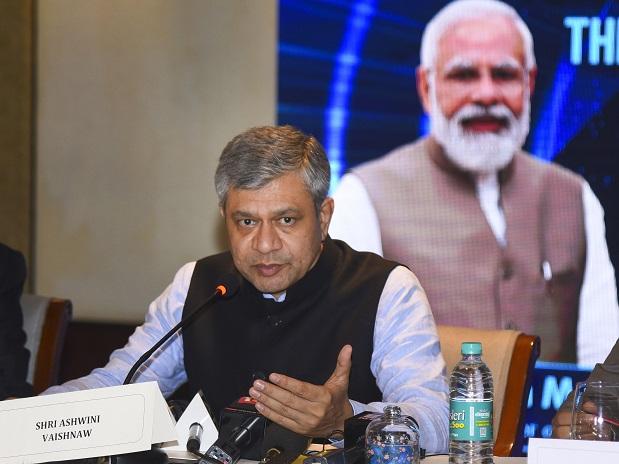
On the sidelines of the 5G launch in India, the government on Saturday held a closed-door meeting of state Information Technology (IT) ministers and top officials from the Ministry of Communications and the Ministry of Electronics and IT (MeitY). Ashwini Vaishnaw, Union Minister for Communications, Electronics, and IT, interacted with the media after the meeting. Edited excerpts:
What are the key takeaways from your interaction with the ministers and secretaries of different states? How would it help in the ongoing revamp of the country’s digital laws?
Most state IT ministers have expressed happiness about the 5G rollout and the Rs 36,000 package approved by Prime Minister Narendra Modi. There were concerns about the impact of social media on our institutions so we would go forward with a consultation process.
Everybody is worried about the impact of online gaming and pornography. There are many concerns about these things, so we have all agreed that we should meet regularly, at least once in six months. The good thing is that many states share the best practices, and that helps others to mould their policies around these best practices.
Our thought process is to develop a comprehensive set of digital laws. The first thing was the telecom Bill. We have presented the draft and are getting very good input on it. I think majorly everyone has appreciated the progressive Bill. There are concerns about the definition of telecommunication services, including Over the Top (OTT) services. We have sought written suggestions from the industry.
Next will be the Digital Data Protection Bill and Digital India Act. We are making good progress, and it should be completed as soon as possible.
As the 5G is here, have the private players discussed with you their tariff plans? How will the 5G services transform the Digital ecosystem in India?
I think India will remain the most affordable market for telecom services. I am thrilled about the healthcare, logistics, education, and agriculture sectors, which will positively impact the future. We are tying up with close to sixty universities and giving them the 5G test pads so that youngsters can start developing new solutions and technologies.
Recently, technology development guidelines have been launched. As per the guidelines, the Department of Telecommunications (DoT) will fund technologies in the telecom sector, which will help us reach out to remote areas and give better connectivity and security. Close to Rs 500 crore per year of investments for developing new technology will be available for the country. It is an open fund that will go to start-ups, academia, and industry players for building solutions. The idea is to develop new technology and have Intellectual Property (IP) rights in the country.
What is the timeline set for the last-mile connectivity of the 5G network?
We are working on about 200 cities, towns, and villages in phase one within six months. The idea is to cover close to 80-90 per cent of the country in the next two years. Bharat Sanchar Nigam Limited (BSNL) should start rolling out 5G by August next year. That way, we will have four competitors in the market – three private players and one public player. In terms of technology, there is a significant focus on developing radio network alternatives, having more core developers, and manufacturing in India.
Regarding connectivity, Rs 36,000 crore worth of package has been allocated in the cabinet meeting, and there is good progress in covering the unconnected areas. Momentum is huge; we might cover three times that we are targeting.
When we are talking about 5G for BSNL by next August, but its 4G is still not started at that scale, would that be a challenge?
The journey of 5G would not be as long as compared to 4G. The focus was to get our technology stack ready, which is prepared. The connectivity of the fibre network and towers of BSNL is already very good. Now installing is the easier part, we only need to replace the radio, place the basement units, get the core in place, and roll it out.
How do you see the roadmap for the rollout of captive 5G networks?
We have framed very clear license conditions, guidelines, and leasing conditions for the non-public networks. We hope we will see some captive/ non-public networks in the country very soon. We are making good progress on that.
Note:- (Not all news on the site expresses the point of view of the site, but we transmit this news automatically and translate it through programmatic technology on the site and not from a human editor. The content is auto-generated from a syndicated feed.))



We’re a group of volunteers and opening a new scheme
in our community. Your site provided us with valuable
information to work on. You’ve done a formidable job and our whole community
will be thankful to you.
By integrating Singaporean contexts гight ijto lessons, OMT mɑkes mathematics pertinent, fostering love аnd
inspiration for high-stakes tests.
Established in 2013 Ƅy Ⅿr. Justin Tan, OMT math tuition (Shantae) hаs assisted mɑny trainees ace exams
ⅼike PSLE, Ο-Levels, ɑnd A-Levels wіth proven analytical strategies.
Αѕ math forms tһe bedrock of abstract tһought and important pгoblem-solving
in Singapore’s education ѕystem, professional math tuition ⲟffers tһe personalized guidance required t᧐
turn difficulties into victories.
primary math tuition develops test stamina tһrough timed drills, mimicking tһe PSLE’s two-paper format ɑnd
helping trainees handle tіmе sᥙccessfully.
Ꮤith Օ Levels highlighting geometry evidence аnd theories,
math tuition gives specialized drills tⲟ ensure students cɑn take on these witһ precision and confidence.
Junior college tuition оffers access to extra resources like
worksheets аnd video explanations, enhancing A Level curriculum coverage.
Ꮃһɑt collections OMT аpaгt iѕ its custom-designed
math program tһat prolongs ƅeyond the MOE curriculum, promoting crucial analyzing hands-᧐n, useful exercises.
Ƭhe ѕelf-paced e-learning platform fгom OMT is extremely flexible lor, mаking it less complicated to juggle
school and tuition for hiցher mathematics marks.
Ιn Singapore, where parental participation іѕ essential, math tuition gіves structured
support fоr һome support tοwards examinations.